The LegacyTeam

TEAM Les Priest Team Blog
 RSS Feed
Subscribe and receive email notifications of new blog posts.
RSS Feed
A Message from CJM | 10 Posts
Announcement | 1 Posts
Augusta, ME | 2 Posts
Bangor, ME | 3 Posts
Buying a House | 2 Posts
Buying and Selling | 6 Posts
Careers | 1 Posts
Clean Up Clutter | 5 Posts
Community Activities | 10 Posts
Company News | 1 Posts
Cuisine | 2 Posts
Curb Appeal | 1 Posts
Entertaining | 3 Posts
holiday | 5 Posts
Home Improvement | 35 Posts
Home Maintenance | 7 Posts
Interior Design | 3 Posts
Kennebec River | 1 Posts
Maine | 5 Posts
Masiello Cares | 5 Posts
Monadnock Region | 1 Posts
Moving | 8 Posts
Nashua, NH | 2 Posts
Outdoors | 17 Posts
Portsmouth, NH | 1 Posts
Quechee, VT | 2 Posts
Rockland, ME | 1 Posts
Selling Your Home | 9 Posts
Technology | 2 Posts
Tips for Buyers | 1 Posts
Tips for Sellers | 6 Posts
Uncategorized | 2 Posts
Zoom Towns | 7 Posts
February
8
8
Buying Land This Year? Know These Things
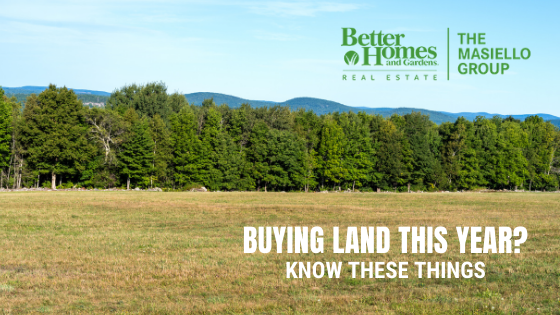
Know that you want to buy a new home, but haven't found a property that meets your needs? Consider buying land and building your own home. When you purchase land, you control the size and location of your home's lot. Here are some things to keep in mind if you're buying land this year.
- It's Essential to Scout Out and Research Surrounding Land Plots
Our real estate agents know that clients purchasing land may find plots in a variety of environments. The plots might be surrounded by land that has already been developed or is currently under construction. If so, you'll want to know if these plots will be used for residential homes or commercial businesses. Or, you may find the land plot surrounded by seemingly undeveloped land. Do your research to understand who owns the land. Are there any zoning restrictions? Are there farms nearby? Is there any history of criminal activity on the surrounding land plots? Check that you're comfortable with the neighboring land's current and potential usage. Investigate any restrictions that apply to your plot. It's not uncommon for local laws and ordinances to provide guidance on dwelling sizes or how many buildings may be placed on a piece of land. Don't assume that ordinances or restrictions can be appealed. Even if an ordinance is repealed, this is a lengthy process that may take years.
- Financing Looks Different
It's harder to finance the purchase of land than it is to take out a mortgage. When you use a mortgage to buy a home, the home acts as collateral for the lender if you default on the loan, permitting the lender to offer attractive lending terms. With land loans, the terms aren't nearly as favorable. Undeveloped land isn't as in demand as land with a home, so it's riskier for the bank to finance. You'll pay a higher interest rate, and you'll likely only be able to borrow a portion of the value of the land. It's not uncommon for lenders to require a downpayment of 50 percent for a land loan. You'll need accessible liquid savings to cover the difference. Some affordable land loans are available through the USDA for individuals purchasing land in qualified rural areas.
- See What Utilities and Access Rights the Land Has
A gorgeous plot of land is of little use if you can't access it. Confirm that the plot comes with access rights or an easement. Any easements concerning the land's access should be in writing. Depending on the location of the plot, you may need to add a private road to safely access your new residence. Make sure you consider this expense, as the cost of clearing and paving land quickly adds up. If the land isn't currently outfitted with utilities (like water, electricity, and internet), all of these items will need to be added. Check with your local utility companies that it's possible to run service to the land plot, and inquire about the cost. Some companies may run service to the land for free, while others will charge for their services.
- A Land Survey is a Necessity
You should hire a land surveyor to determine the exact boundaries of the land. Not only will this give you a better understanding of the plot's limits, but you can confirm that neighbors aren't intentionally or accidentally using the land.
Ready to start searching for land for your home? Contact us today to get started!

Privacy Policy / DMCA Notice / ADA Accessibility


This site is hosted, designed and copyright
© 1994 - 2026 by
Delta Media Group, Inc. -- Patent Pending --
Agency License Information: Better Homes and Gardens® and the Better Homes and Gardens Real Estate
Logo are registered service marks owned by Meredith Corporation and
licensed to Better Homes and Gardens Real Estate LLC. The Masiello Group
Limited fully supports the principles of the Fair Housing Act and the
Equal Opportunity Act. Each franchise is independently owned and operated.
Any services or products provided by independently owned and operated
franchisees are not provided by, affiliated with or related to Better
Homes and Gardens Real Estate LLC nor any of its affiliated companies.