The LegacyTeam

TEAM Les Priest Team Blog
 RSS Feed
Subscribe and receive email notifications of new blog posts.
RSS Feed
A Message from CJM | 10 Posts
Announcement | 1 Posts
Augusta, ME | 2 Posts
Bangor, ME | 3 Posts
Buying a House | 2 Posts
Buying and Selling | 6 Posts
Careers | 1 Posts
Clean Up Clutter | 5 Posts
Community Activities | 10 Posts
Company News | 1 Posts
Cuisine | 2 Posts
Curb Appeal | 1 Posts
Entertaining | 3 Posts
holiday | 5 Posts
Home Improvement | 35 Posts
Home Maintenance | 7 Posts
Interior Design | 3 Posts
Kennebec River | 1 Posts
Maine | 5 Posts
Masiello Cares | 5 Posts
Monadnock Region | 1 Posts
Moving | 8 Posts
Nashua, NH | 2 Posts
Outdoors | 17 Posts
Portsmouth, NH | 1 Posts
Quechee, VT | 2 Posts
Rockland, ME | 1 Posts
Selling Your Home | 9 Posts
Technology | 2 Posts
Tips for Buyers | 1 Posts
Tips for Sellers | 6 Posts
Uncategorized | 2 Posts
Zoom Towns | 7 Posts
March
21
21
Popular Home Styles in Northern New England
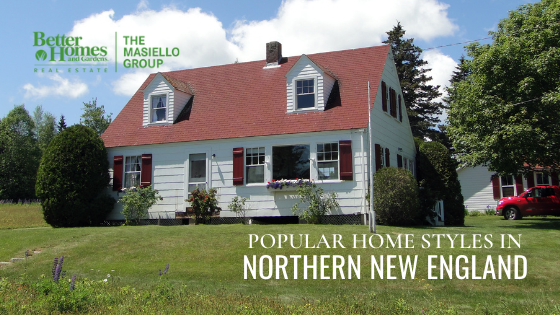
The man-made scenery in Northern New England is nearly as eye-catching as the natural landscape. Whether you're a history buff or just appreciative of beautiful designs, the area's range of architectural styles is endlessly fascinating. Our real estate agents take a look at some of the more popular home styles and what makes them so compelling.
- Colonial
Fittingly, Colonial-style homes were the earliest structures in New England. Frequently described as plain yet sturdy, these houses had many characteristics in common with the settlers who built them. Constructed from wood, Colonial homes have no eaves, shutters, porches, window trim, or other decorative features to add visual interest. The houses had two stories, with living quarters on the first floor and bedrooms upstairs, along with diamond-paned windows and a large chimney in the middle of the roof.
After a while, Colonial-style gave rise to two variations. In order to accommodate growing families, the homes were built out from the back, creating a distinctive, one-sided sloped roof. This style became known as "saltbox" due to its resemblance to wooden salt containers. The second style is the classic Cape Cod home. Like Colonial homes, Cape Cods were built for function over style. The defining characteristic of these rectangular houses is a central door flanked by two sets of symmetrical windows. - Georgian
Georgian architecture, the next progression from Colonial style, was named after the first four King Georges back in the homeland. Much like Colonials before them, Georgian homes are relatively unadorned. The primary difference is their proper, orderly appearance, representing both the increasing prosperity of the colonists and the mannerly demeanor of the British.
While these homes are generally larger than Colonials, two stories high by two rooms deep, the biggest change is in the regimented symmetry of the exterior. Upper and lower windows line up exactly, with evenly spaced intervals going across. Decorations are primarily limited to doors, which are paneled rather than planked, flanked by flattened columns which support an overhead crown. - Greek Revival
As the early colonists built their fledgling nation, they found themselves drawn to all things democratic, including the architectural styles of the public buildings found in ancient Greece. As a result, home styles took a radical turn towards Greek Revival in the early 19th century. Not surprisingly, these homes stand out in sharp contrast to most of the others around New England. The most prominent difference is a 90-degree rotation to create a front-gabled profile, allowing cornice detailing to be displayed to greater effect. Other features include Grecian doorway moldings and the signature columns supporting porch roofs. - Victorian
Coming into popularity in the late 19th century, Victorian-style also took its name from British royalty. But unlike the stoic formality of Georgian style, Victorian homes are marked by a joyous, unfettered freedom that make them a complete departure from earlier homes. Victorian style is considered to be "eclectic," which is a shorthand way of saying it defies easy categorization.
With a number of elements freely borrowed from other styles, there are a few features that loosely define Victorian architecture. Irregular floor plans, porches, asymmetrical placement of doors and windows, "gingerbread" detailing, and patterned roofs are some of the touches that differentiate Victorian homes from earlier, more austere designs. Subsets of Victorian include Second Empire, with their stately mansard roofs, and Queen Anne, denoted by an overall "pointy" appearance. - Shingle
Growing prosperity allowed people to acquire second homes for use as summer getaways. Instead of incorporating the ornate designs of Victorian, many of these homes embraced Colonial simplicity in the style known as Shingle. This style is particularly well-suited to seaside communities, where exposure to salt air creates an attractively weathered patina in the shingles. In fact, during later times, some creative architects achieved the look in newly-constructed homes by soaking shingles in buttermilk and allowing them to dry. The other trademark feature is a gambrel roof, in which both sides have two slopes to create a somewhat curved appearance. - Farmhouse
No architectural style may be more quintessentially American than Farmhouse. This warm, inviting style honors love of family and love of land, two principles that figure prominently in solid New England values. Specific details include clean lines, gabled roofs with dormers, and wood siding. Covered porches often wrap around the entire house, adding to the cozy appeal. Spacious kitchens, a must in those days of the past, are still the centerpiece of Farmhouse homes. While the original Farmhouse style remains popular, some homes today add modern touches such as monochromatic vertical siding, first-floor master suites, and open floor plans.
The Masiello Group has all the answers to your questions about Northern New England homes. Contact us today to speak with one of our experienced real estate agents.

Privacy Policy / DMCA Notice / ADA Accessibility


This site is hosted, designed and copyright
© 1994 - 2026 by
Delta Media Group, Inc. -- Patent Pending --
Agency License Information: Better Homes and Gardens® and the Better Homes and Gardens Real Estate
Logo are registered service marks owned by Meredith Corporation and
licensed to Better Homes and Gardens Real Estate LLC. The Masiello Group
Limited fully supports the principles of the Fair Housing Act and the
Equal Opportunity Act. Each franchise is independently owned and operated.
Any services or products provided by independently owned and operated
franchisees are not provided by, affiliated with or related to Better
Homes and Gardens Real Estate LLC nor any of its affiliated companies.